Unit 5 - Long-Run Consequences of Stabilization Policies
Printable Cheat Sheets for Every Unit
Everything you need to ace your exam, all on a single page.
Download PDF Cheat SheetsTable of Contents
5.1 - Fiscal and Monetary Policy Actions in the Short Run
Key Terms & Definitions
Fiscal Policy
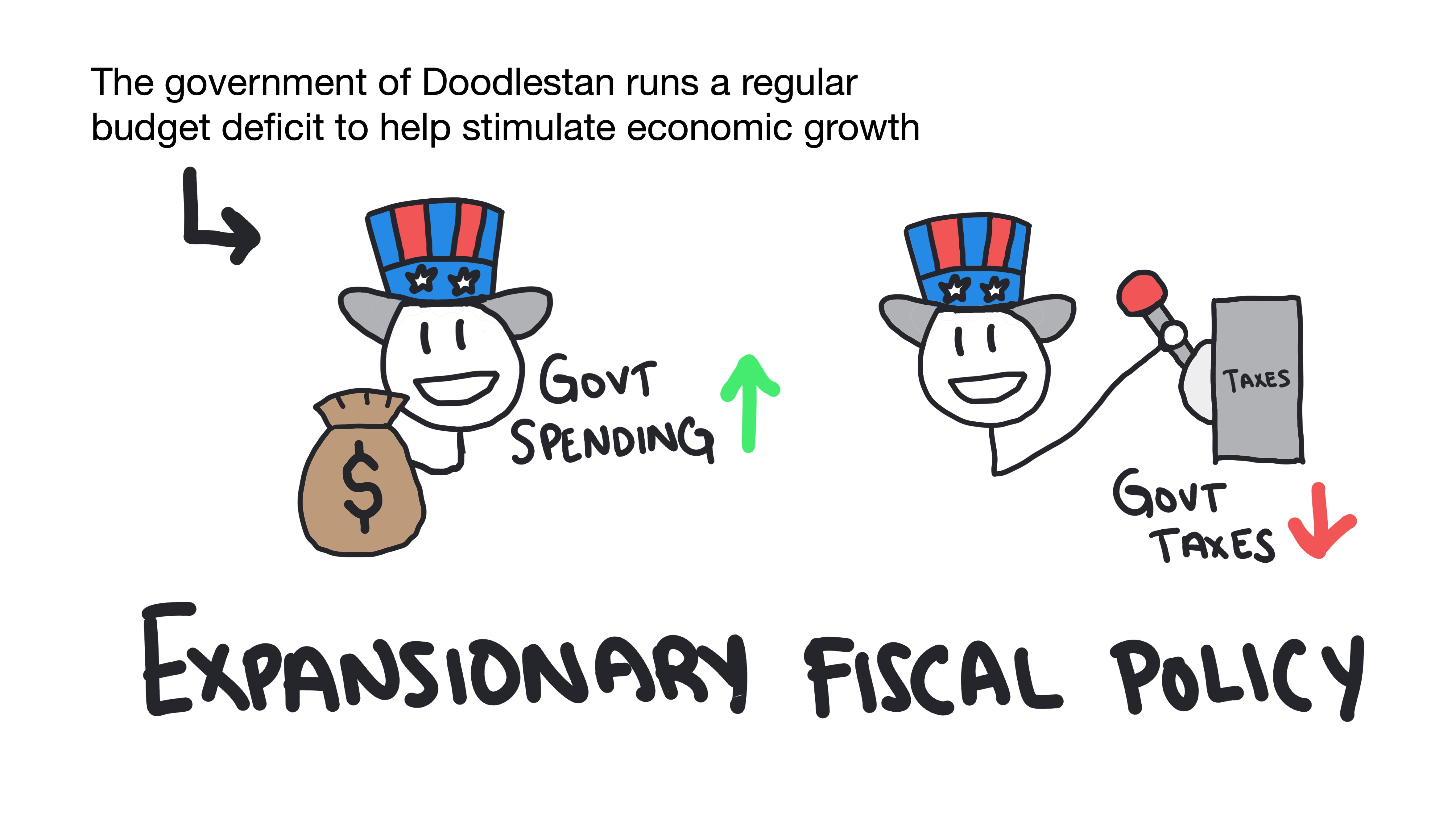
The government’s use of spending and taxation to influence aggregate demand.
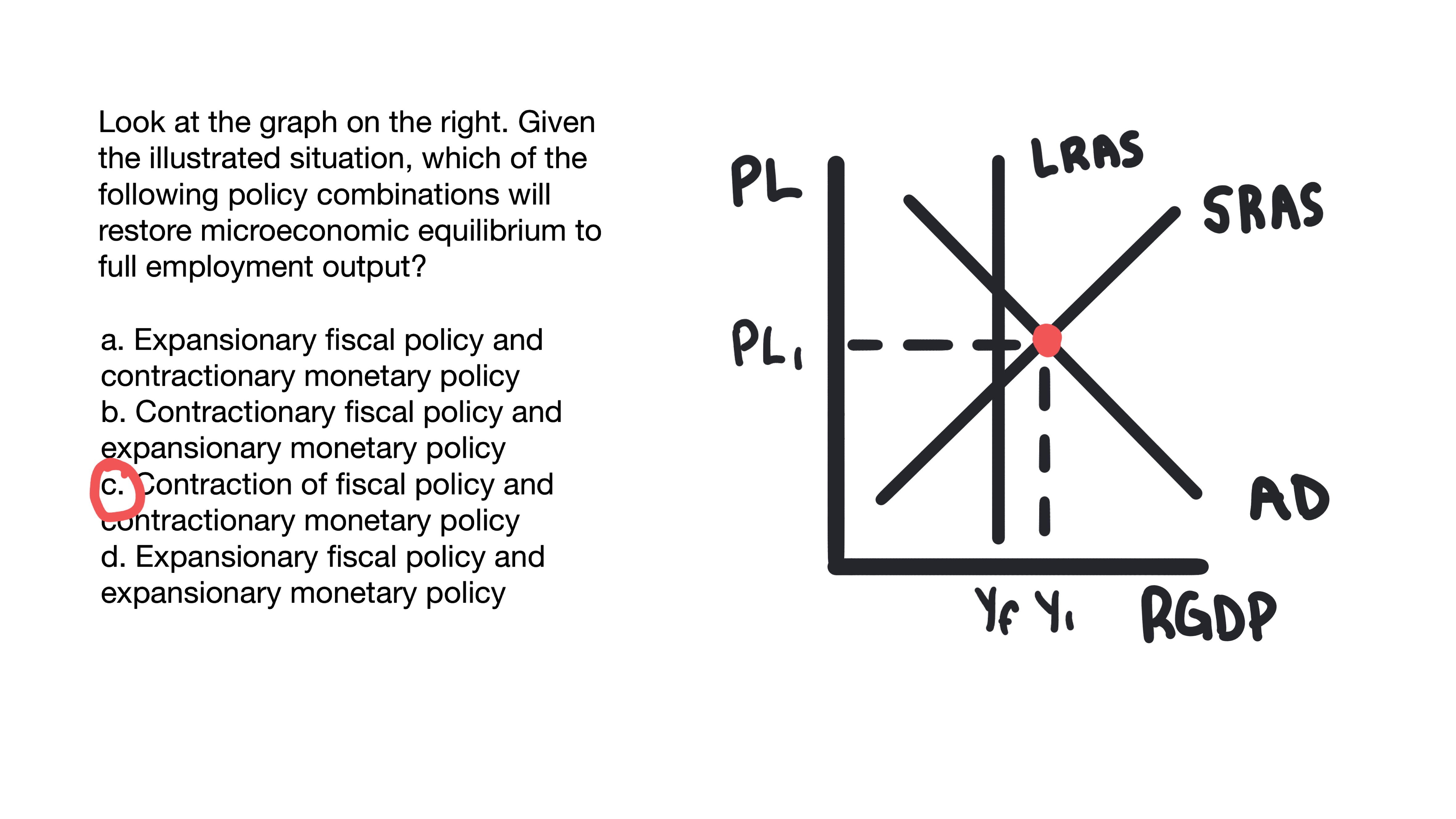
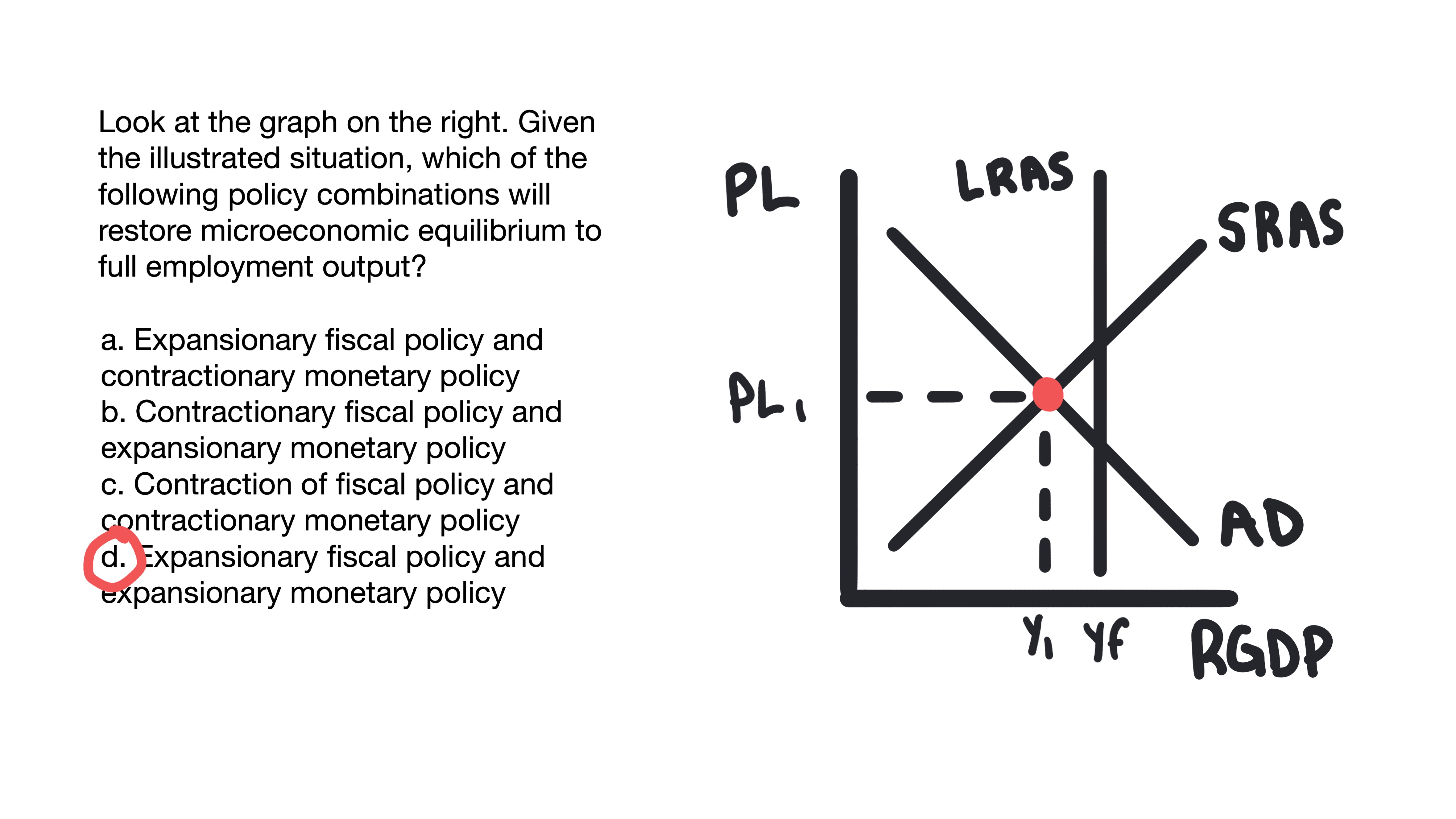
- •Expansionary Policy (for recession): Increase Gov. Spending (G) or Decrease Taxes (T).
- •Contractionary Policy (for inflation): Decrease Gov. Spending (G) or Increase Taxes (T).
Monetary Policy
Actions taken by the central bank to manage the money supply and influence aggregate demand.
- •Expansionary Policy (for recession): Buy bonds, decrease discount rate, or decrease required reserve ratio.
- •Contractionary Policy (for inflation): Sell bonds, increase discount rate, or increase required reserve ratio.
Policy Mix Effects
The combined impact on the economy when the government and central bank use fiscal and monetary policies simultaneously.
- •The impact on the real interest rate (RIR) depends on the mix of policies.
- •Expansionary Fiscal (G↑) + Contractionary Monetary (MS↓) → RIR ↑ significantly.
- •Expansionary Fiscal (G↑) + Expansionary Monetary (MS↑) → RIR effect is indeterminate (policies work in opposite directions on interest rates).
Whiteboards
Practice MCQs
Test your understanding of 5.1
Suppose an economy is in a recession. Policymakers implement expansionary fiscal policy while the central bank simultaneously implements contractionary monetary policy. What is the most likely combined effect on real output and real interest rates in the short run?
5.2 - The Phillips Curve
Video
Key Terms & Definitions
Phillips Curve
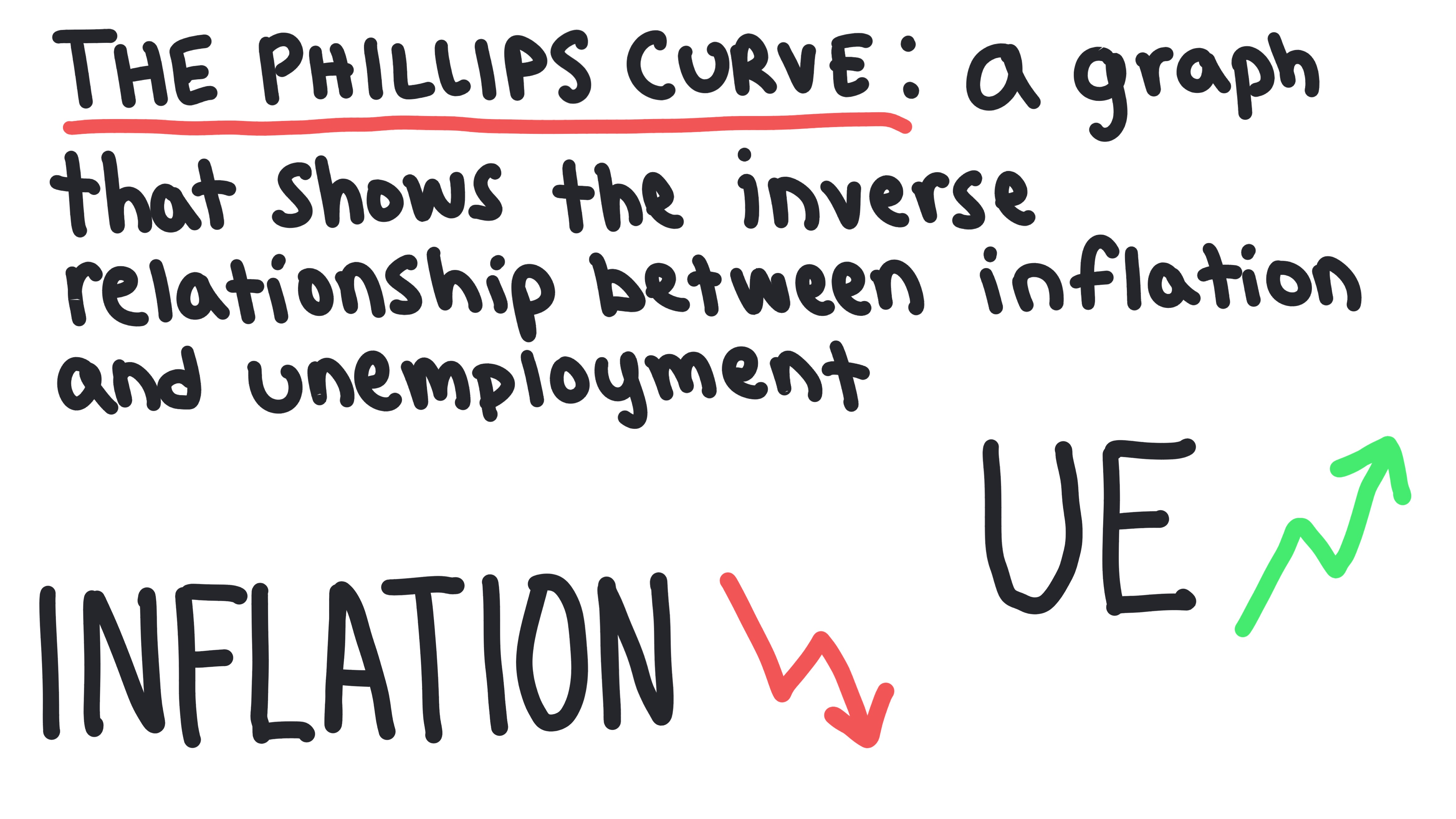
A model that illustrates the relationship between inflation and unemployment.
- •Includes both the Short-Run Phillips Curve (SRPC) and the Long-Run Phillips Curve (LRPC).
- •The Phillips Curve model and the AD/AS model are mirror images; both show the same changes to the economy.
Short-Run Phillips Curve (SRPC)
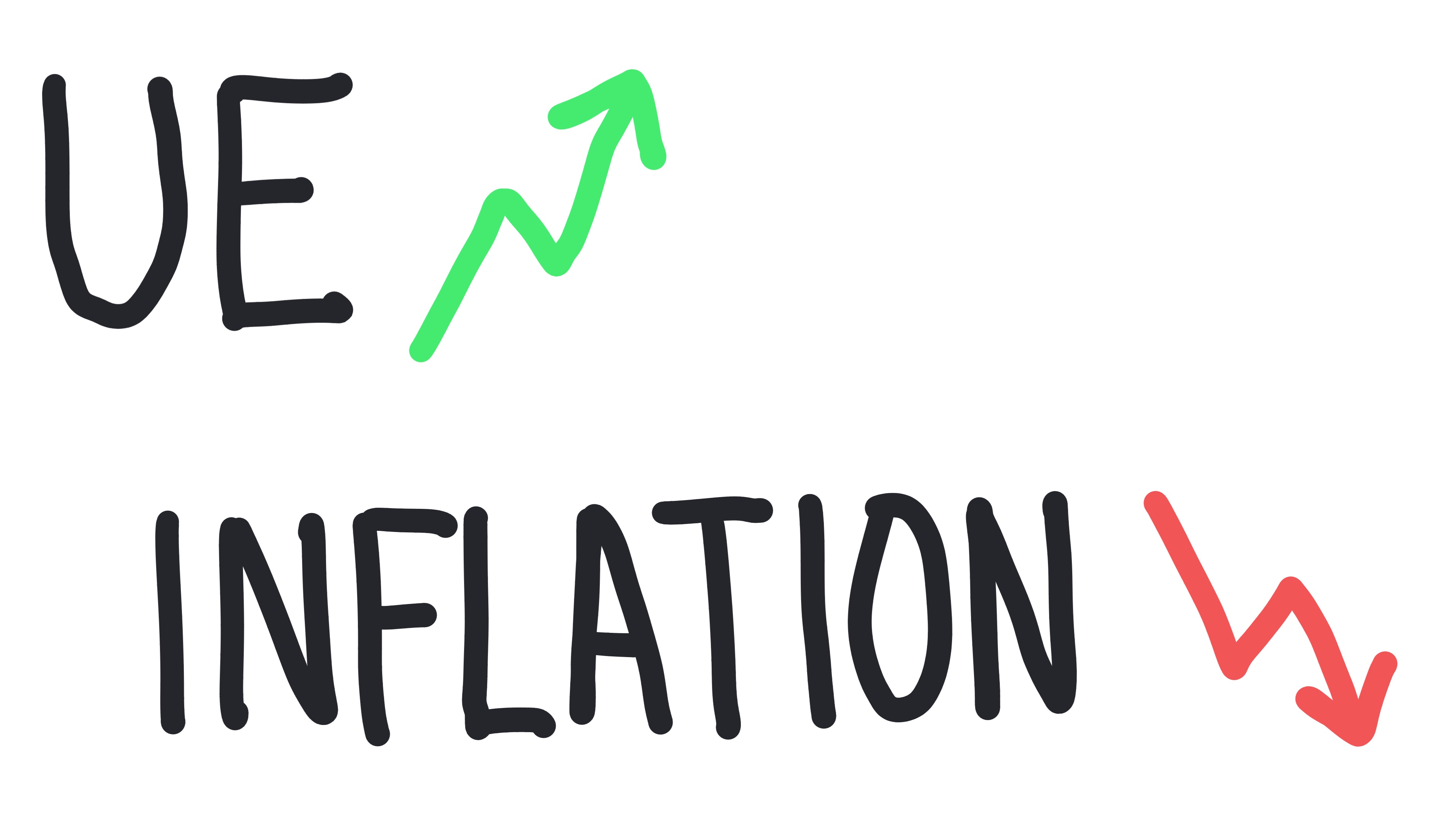
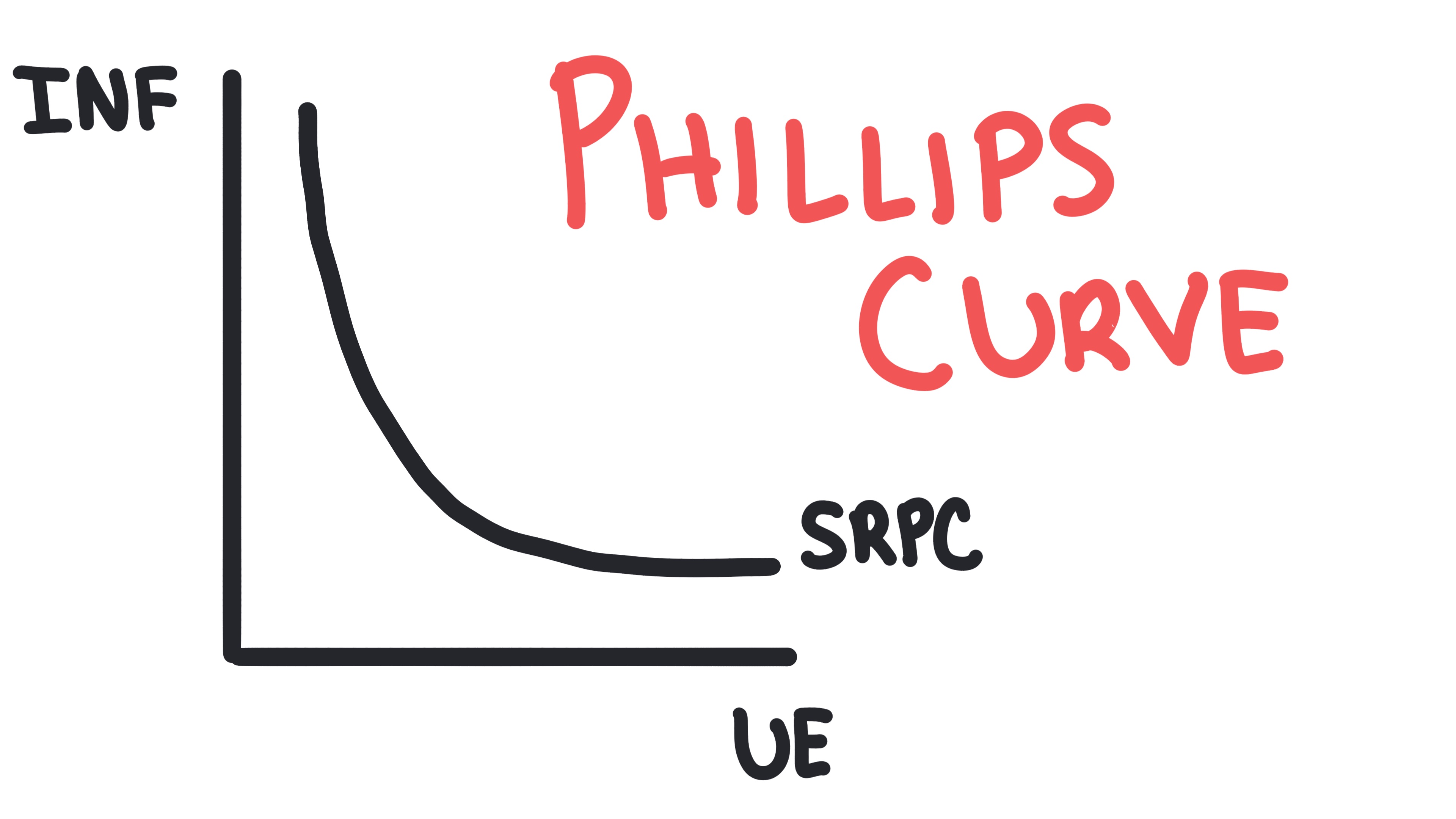
A curve showing the short-run inverse relationship between the inflation rate and the unemployment rate.
- •Downward sloping, showing a trade-off between inflation and unemployment.
Long-Run Phillips Curve (LRPC)
A vertical line at the natural rate of unemployment (NAIRU).
- •Shows there is no long-run trade-off between inflation and unemployment.
- •This means expansionary policies only lead to inflation in the long run, without a lasting decrease in unemployment.
NRU (Natural Rate of Unemployment)
The unemployment rate consistent with full employment; the rate at which the LRPC is vertical.
- •Also known as the full-employment rate of unemployment.
Movements Along the SRPC
A change in the combination of inflation and unemployment along a stable Short-Run Phillips Curve, caused by shifts in Aggregate Demand.
- •AD Right → Move up/left along SRPC (lower unemployment, higher inflation).
- •AD Left → Move down/right along SRPC (higher unemployment, lower inflation).
Shifts of the SRPC
A change in the short-run trade-off between inflation and unemployment, moving the entire Short-Run Phillips Curve.
- •Caused by changes in inflationary expectations or supply shocks (SRAS shifts).
- •Negative supply shock (Stagflation) → SRPC shifts right (worse inflation and unemployment at any point).
- •Positive supply shock → SRPC shifts left (improved trade-off).
- •Increase in inflationary expectations → SRPC shifts right.
Whiteboards
Practice MCQs
Test your understanding of 5.2
An increase in aggregate demand that causes inflation will, in the short run, lead to which of the following on a standard Phillips curve diagram?
5.3 - Money Growth and Inflation
Key Terms & Definitions
Quantity Theory of Money
The theory that, in the long run, the quantity of money determines the price level and inflation rate.
- •Based on the Equation of Exchange: M x V = P x Y
- •M = Money Supply, V = Velocity of Money
- •P = Price Level, Y = Real GDP
- •P x Y = Nominal GDP; M x V also equals Nominal GDP
- •If V and Y are constant, a % change in M leads to an equal % change in P (inflation).
Equation of Exchange
The formula M x V = P x Y, which links the money supply, velocity, price level, and real output.
Velocity of Money (V)
The average number of times a unit of money (e.g., a dollar) is spent on final goods and services in a year.
- •Often assumed to be relatively stable.
Hyperinflation
A very rapid, excessive, and out-of-control increase in the price level, often caused by a massive increase in the money supply.
Practice MCQs
Test your understanding of 5.3
According to the quantity theory of money, if the money supply (M) is $2,000 billion, the velocity of money (V) is 4, and real GDP (Y) is $4,000 billion, what is the aggregate price level (P)?
5.4 - Government Deficits and the National Debt
Key Terms & Definitions
Federal Budget
An annual plan outlining the government's expected revenues (taxes) and expenditures (outlays).
- •Can exist in one of three states: deficit, surplus, or balanced.
Government Outlays
The total spending by the government, including transfer payments and government purchases (G).
Budget Deficit
When government outlays (spending) exceed tax revenue in a given year. (Outlays > Revenue)
- •Increases the national debt.
Budget Surplus
When tax revenue exceeds government outlays (spending) in a given year. (Revenue > Outlays)
- •Can be used to pay down the national debt.
Balanced Budget
When government outlays (spending) are equal to tax revenue in a given year. (Outlays = Revenue)
Financing a Budget Deficit
The method the government uses to pay for its deficit, primarily through borrowing money by selling government bonds (securities) to investors.
- •Government sells bonds to both domestic and foreign investors.
- •The government borrows from bondholders, promising to pay them back with interest in the future.
National Debt
The total accumulation of all past budget deficits, minus any surpluses.
- •The total amount of money the government owes to its bondholders.
- •Deficits add to the national debt, surpluses reduce it.
Interest Payments (on Debt)
The money the government must pay to its bondholders for the interest accrued on the national debt.
Crowding Out
An economic effect where government deficit spending increases real interest rates, causing a decrease in private investment.
- •Government deficit → Demand for loanable funds ↑ → Real Interest Rate ↑ → Private Investment (I) ↓
- •This dampens the full effect of expansionary fiscal policy, as the increase in government spending is partially offset by the decrease in private investment.
Practice MCQs
Test your understanding of 5.4
Which statement accurately describes the difference between the government budget deficit and the national debt?
5.5 - Crowding Out
Video
Key Terms & Definitions
Crowding Out
An economic effect where government deficit spending increases real interest rates, causing a decrease in private investment.
- •Government deficit → Demand for loanable funds ↑ → Real Interest Rate ↑ → Private Investment (I) ↓
- •This dampens the full effect of expansionary fiscal policy, as the increase in government spending is partially offset by the decrease in private investment.
Capital Stock
The total accumulation of physical capital—tools, machinery, equipment, and structures—used to produce goods and services.
- •Impact of Crowding Out: Government borrowing increases real interest rates, which decreases private investment, leading to a smaller future capital stock.
Crowding Out and Long-Run Economic Growth
The long-run negative effect of persistent government deficits, where higher real interest rates reduce private investment and capital accumulation, slowing economic growth.
- •Government borrowing increases real interest rates, reducing private investment and capital formation.
- •Less investment in physical capital (machinery, factories, infrastructure) results in slower economic growth.
- •Reflected in smaller rightward shifts of the LRAS curve and PPC, meaning potential output grows more slowly than it otherwise would.
Practice MCQs
Test your understanding of 5.5
If the government pursues expansionary fiscal policy while the central bank holds the money supply constant (or uses limited reserves tools), what is the likely impact on real interest rates and private investment?
5.6 - Economic Growth
Key Terms & Definitions
Capital Stock
The total accumulation of physical capital—tools, machinery, equipment, and structures—used to produce goods and services.
- •Impact of Crowding Out: Government borrowing increases real interest rates, which decreases private investment, leading to a smaller future capital stock.
Crowding Out and Long-Run Economic Growth
The long-run negative effect of persistent government deficits, where higher real interest rates reduce private investment and capital accumulation, slowing economic growth.
- •Government borrowing increases real interest rates, reducing private investment and capital formation.
- •Less investment in physical capital (machinery, factories, infrastructure) results in slower economic growth.
- •Reflected in smaller rightward shifts of the LRAS curve and PPC, meaning potential output grows more slowly than it otherwise would.
Economic Growth
A sustained increase in an economy’s potential output (real GDP) or real GDP per capita over time.
Real GDP per Capita
The total real output (Real GDP) of a country divided by its total population; a measure of the average standard of living.
- •Formula: Real GDP / Population
Economic Growth (on the PPC)
How economic growth is illustrated on the Production Possibilities Curve model as an outward shift of the entire curve.
- •Represents an increase in the economy's productive capacity, meaning it can now produce more of both goods than before.
- •Occurs when there is an increase in resources, improvements in technology, or growth in the factors of production.
Economic Growth (on the AD-AS Model)
How economic growth is illustrated on the Aggregate Demand-Aggregate Supply model as a rightward shift of the Long-Run Aggregate Supply (LRAS) curve.
- •Represents an increase in the economy's potential output, or full-employment output (Yf).
- •Indicates the economy can now produce more goods and services at full employment, reflecting an increase in productive capacity due to growth in resources, technology, or factors of production.
Sources of Economic Growth
The key factors that shift the LRAS and PPC outward, increasing potential output.
- •Increase in Physical Capital (K): more machines, factories
- •Increase in Human Capital (H): better education, skills
- •Advancements in Technology (A)
- •Increase in quantity/quality of Natural Resources or Labor (L)
- •These factors work together to expand an economy's productive capacity over time.
Productivity
Output per worker; a key driver of long-run economic growth and real wages.
- •Driven by increases in technology, physical capital, and human capital.
Practice MCQs
Test your understanding of 5.6
How does the crowding out effect potentially impact long-run economic growth?
5.7 - Public Policy and Economic Growth
Key Terms & Definitions
Sources of Economic Growth
The key factors that shift the LRAS and PPC outward, increasing potential output.
- •Increase in Physical Capital (K): more machines, factories
- •Increase in Human Capital (H): better education, skills
- •Advancements in Technology (A)
- •Increase in quantity/quality of Natural Resources or Labor (L)
- •These factors work together to expand an economy's productive capacity over time.
Supply-Side Economics
A school of thought that advocates for government policies focused on increasing aggregate supply (LRAS) to achieve long-run growth, rather than focusing primarily on aggregate demand.
- •Also known as "trickle-down" economics.
- •Emphasizes policies that increase incentives to work, save, and invest.
- •Examples: Tax cuts for businesses, deregulation, and other policies designed to encourage production and investment.
- •Based on the belief that benefits will eventually "trickle down" to all members of society.
Promoting Physical Capital Development
Government policies aimed at increasing the amount of tools, machinery, and infrastructure (capital formation) to promote long-run economic growth.
- •These policies encourage both private and public investment in physical capital.
- •Examples: Investment tax credits (reduce cost of business investment), lower corporate income taxes (leave more money for capital spending), direct government spending on public infrastructure (roads, bridges, internet networks).
- •By increasing physical capital, these policies shift the LRAS curve to the right and expand the economy's productive capacity.
Promoting Human Capital Development
Government policies aimed at increasing the knowledge, skills, and health of the workforce to promote long-run economic growth.
- •Examples: Government spending on public education, job training programs, subsidies for healthcare, student loans or grants.
- •By improving human capital, workers become more productive, which increases potential output and shifts the LRAS curve to the right.
Practice MCQs
Test your understanding of 5.7
Supply-side fiscal policies, such as targeted tax cuts on business investment or research and development, are primarily intended to: