Unit 6 - Market Failure and the Role of Government
Table of Contents
6.1 - Socially Efficient and Inefficient Market Outcomes
Key Terms & Definitions
Market Failure
A situation where the free market fails to satisfy society’s wants or allocates resources inefficiently.
- •The private market outcome does not equal the socially optimal outcome.
- •Result: The government must intervene to fix the inefficiency.
6.2 - Externalities
Key Terms & Definitions
Externality
A third-party cost or benefit resulting from a transaction between a buyer and a seller.
- •Can be positive (benefit) or negative (cost).
- •Causes the market to fail because the private decision-makers do not consider these external effects.
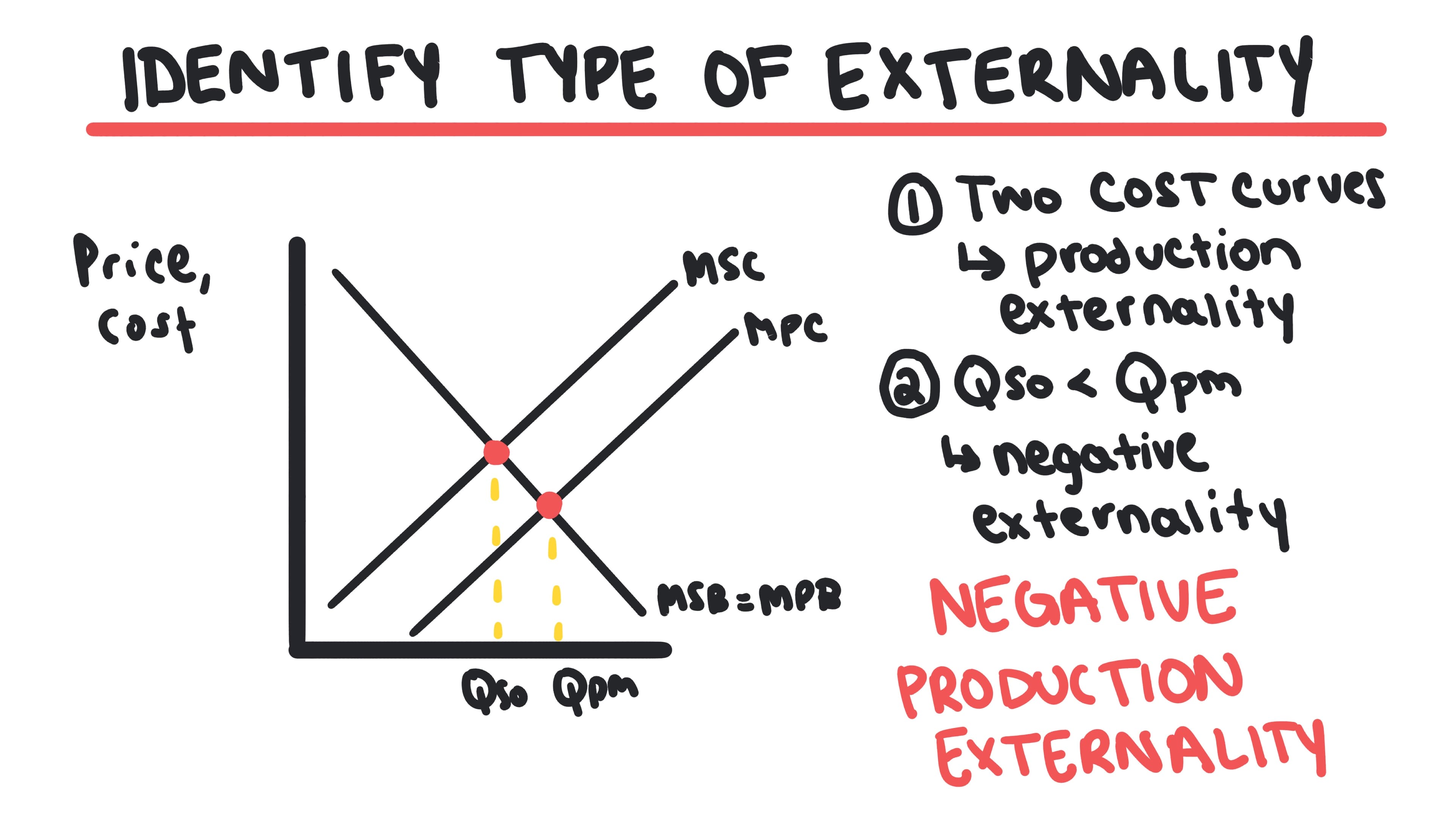
Negative Externality
A situation where production or consumption imposes a cost on a third party (e.g., pollution, smoking).
- •Marginal Social Cost (MSC) > Marginal Private Cost (MPC).
- •The market Overproduces (Q_market > Q_social).
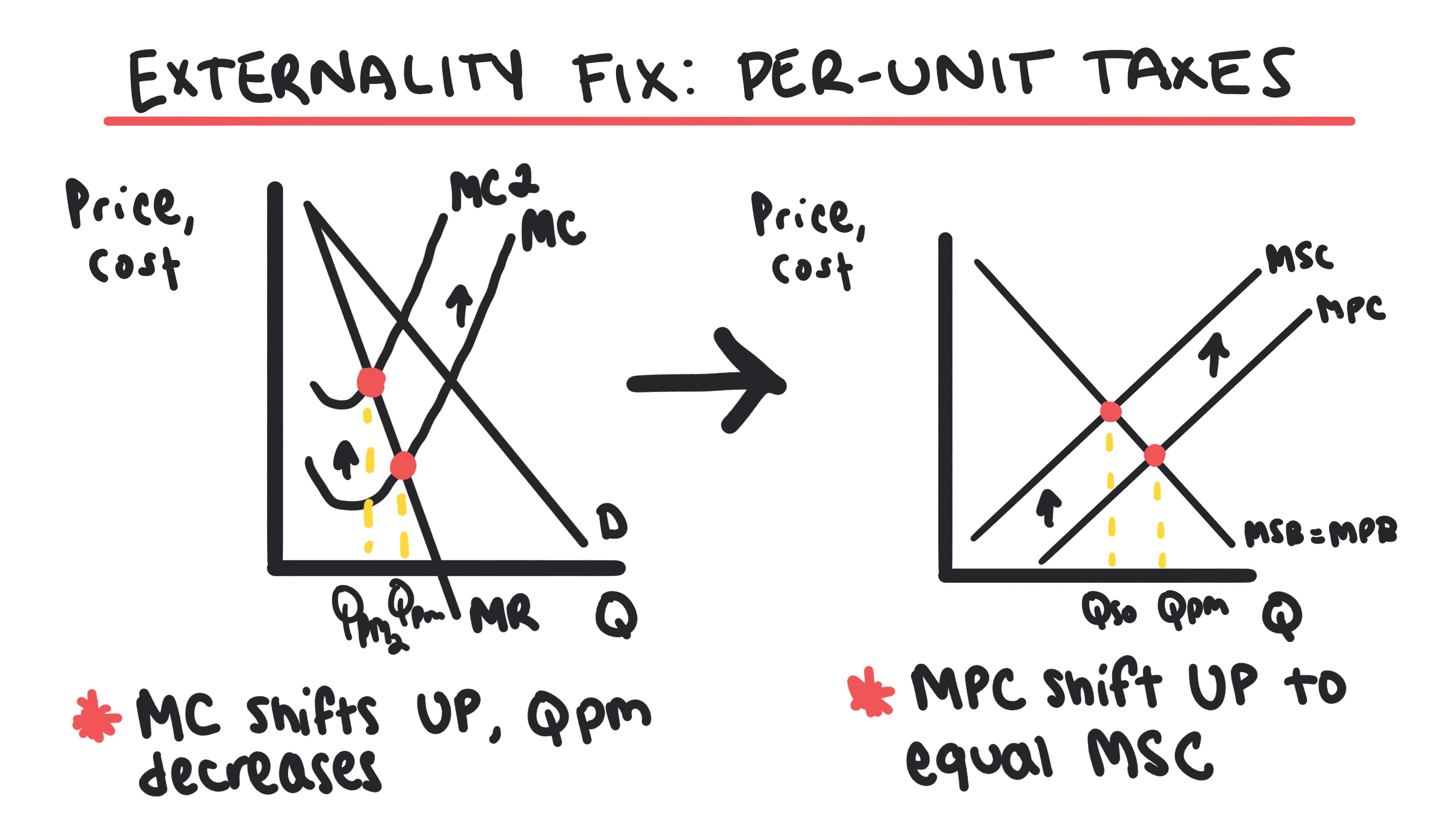
- •Fix: Per-unit Tax.
Positive Externality
A situation where production or consumption creates a benefit for a third party (e.g., vaccines, education).
- •Marginal Social Benefit (MSB) > Marginal Private Benefit (MPB).
- •The market Underproduces (Q_market < Q_social).
- •Fix: Per-unit Subsidy.
Per-Unit Taxes and Subsidies
Government tools used to correct externalities by shifting the private cost or benefit curves.
- •Taxing a negative externality shifts MPC up to meet MSC.
- •Subsidizing a positive externality shifts MPB up to meet MSB.
Whiteboards
6.3 - Public and Private Goods
Key Terms & Definitions
Public Good
A good that is both non-excludable and non-rival in consumption.
- •Examples: National defense, public parks, streetlights.
- •The free market tends to underproduce these due to the Free Rider Problem.
Non-Excludable
A characteristic of a good where it is impossible (or very costly) to prevent people who haven't paid from using it.
- •Example: You can't stop someone from enjoying the light from a streetlight.
Free Rider Problem
An issue where individuals benefit from a public good without paying for it, leading to underproduction by private firms.
- •Since firms cannot profit from free riders, the government must provide the good using tax revenue.
Checkpoint
Test your understanding of 6.1
A socially efficient market outcome occurs where:
Checkpoint
Test your understanding of 6.2
A negative externality occurs when:
6.4 - The Effects of Government Intervention in Different Market Structures
Key Terms & Definitions
Antitrust Laws
Legislation designed to prevent monopolies and promote competition.
- •Used to break up monopolies or stop mergers that would hurt consumers.
- •Example: The Sherman Antitrust Act.
Per-Unit Taxes and Subsidies
Government tools used to correct externalities by shifting the private cost or benefit curves.
- •Taxing a negative externality shifts MPC up to meet MSC.
- •Subsidizing a positive externality shifts MPB up to meet MSB.
Lump Sum vs. Per Unit
The distinction between one-time fixed interventions and variable interventions.
- •Lump Sum (Tax/Subsidy): Affects Fixed Costs. Changes Profit, but NOT Quantity or Price.
- •Per Unit (Tax/Subsidy): Affects Variable Costs (MC). Changes Profit, Quantity, AND Price.
6.5 - Inequality
Key Terms & Definitions
Income Inequality
The unequal distribution of household income across the population.
- •The government can measure this using the Lorenz Curve and Gini Coefficient.
Lorenz Curve
A graph that visually represents income inequality.
- •Plots the cumulative percentage of the population against the cumulative percentage of total income.
- •The "banana" shape between the line of perfect equality and the Lorenz curve represents the degree of inequality.
Gini Coefficient
A statistical measure of income inequality ranging from 0 to 1.
- •0 = Perfect Equality (everyone has same income).
- •1 = Perfect Inequality (one person has all the income).
- •Formula: Area A / (Area A + Area B).
Progressive Tax
A tax system where the tax rate increases as income increases.
- •Helps reduce income inequality.
- •Example: Current US Income Tax system.
Regressive Tax
A tax system where the tax rate decreases as income increases (or takes a larger percentage of income from the poor).
- •Increases income inequality.
- •Example: Sales tax (hits lower income earners harder as a % of their income).
Proportional Tax (Flat Tax)
A tax system where the tax rate remains the same regardless of income.
- •Example: A flat 20% tax on everyone.
Checkpoint
Test your understanding of 6.4
Government intervention in markets with externalities can:
Checkpoint
Test your understanding of 6.5
Income inequality measures: