Unit 1 - Basic Economic Concepts
Table of Contents
1.1 - Scarcity
Key Terms & Definitions
Scarcity
The fundamental economic problem that exists because there are limited resources and unlimited wants.
- •The basic economic problem
- •Forces individuals and societies to make choices
- •Exists because resources are limited but wants are unlimited
- •Applies to all economic decisions
Factors of Production
The resources used to produce goods and services: land, labor, capital, and entrepreneurship.
- •Land: natural resources
- •Labor: human effort and skills
- •Capital: human-made resources
- •Entrepreneurship: organizing and risk-taking
Whiteboards


1.2 - Resource Allocation and Economic Systems
Key Terms & Definitions
Economic Systems
The method used by a society to produce and distribute goods and services.
- •Traditional: based on customs and traditions
- •Command: government controls production
- •Market: individuals make economic decisions
- •Mixed: combination of market and government
Free Market Economy
An economic system where individuals own resources and make economic decisions with minimal government involvement.
- •Private ownership of resources
- •Decisions made by individuals and firms
- •Prices determined by supply and demand
- •Limited government intervention
Invisible Hand
The concept that self-interest and competition guide free markets to efficiently allocate resources (coined by Adam Smith).
- •Self-interest promotes social welfare
- •Competition ensures efficiency
- •No central planning needed
- •Foundation of market economics
Command Economy
An economic system where the government makes all economic decisions about production, distribution, and resource allocation.
- •Government owns and controls resources
- •Central planning determines what and how much to produce
- •Prices are set by the government
- •Also known as a planned economy or communism
- •Examples: North Korea, former Soviet Union
Mixed Economy
An economic system that combines elements of both market and command economies, with both private and public ownership of resources.
- •Combines market forces with government intervention
- •Private sector produces most goods and services
- •Government provides public goods and regulates markets
- •Most modern economies are mixed economies
- •Examples: United States, Canada, most European countries
Traditional Economy
An economic system based on customs, traditions, and historical practices, where economic decisions are made based on what has been done in the past.
- •Economic decisions based on customs and traditions
- •Often found in rural, agricultural societies
- •Barter and trade are common
- •Little economic growth or change
- •Examples: Some indigenous communities, rural agricultural societies
Market Economy
An economic system where economic decisions are made by individuals and businesses based on supply and demand, with minimal government intervention.
- •Decisions made by individuals and businesses
- •Prices determined by supply and demand
- •Private ownership of resources
- •Competition drives efficiency
- •Also called capitalism or free market economy
Property Rights
Legal rights to own, use, and dispose of resources, goods, and services. Essential for market economies to function effectively.
- •Right to own property (land, buildings, resources)
- •Right to use property as one sees fit
- •Right to transfer or sell property
- •Protected by law and government
- •Essential for incentives to invest and innovate
- •Foundation of market economies
1.3 - Production Possibilities Curve
Key Terms & Definitions
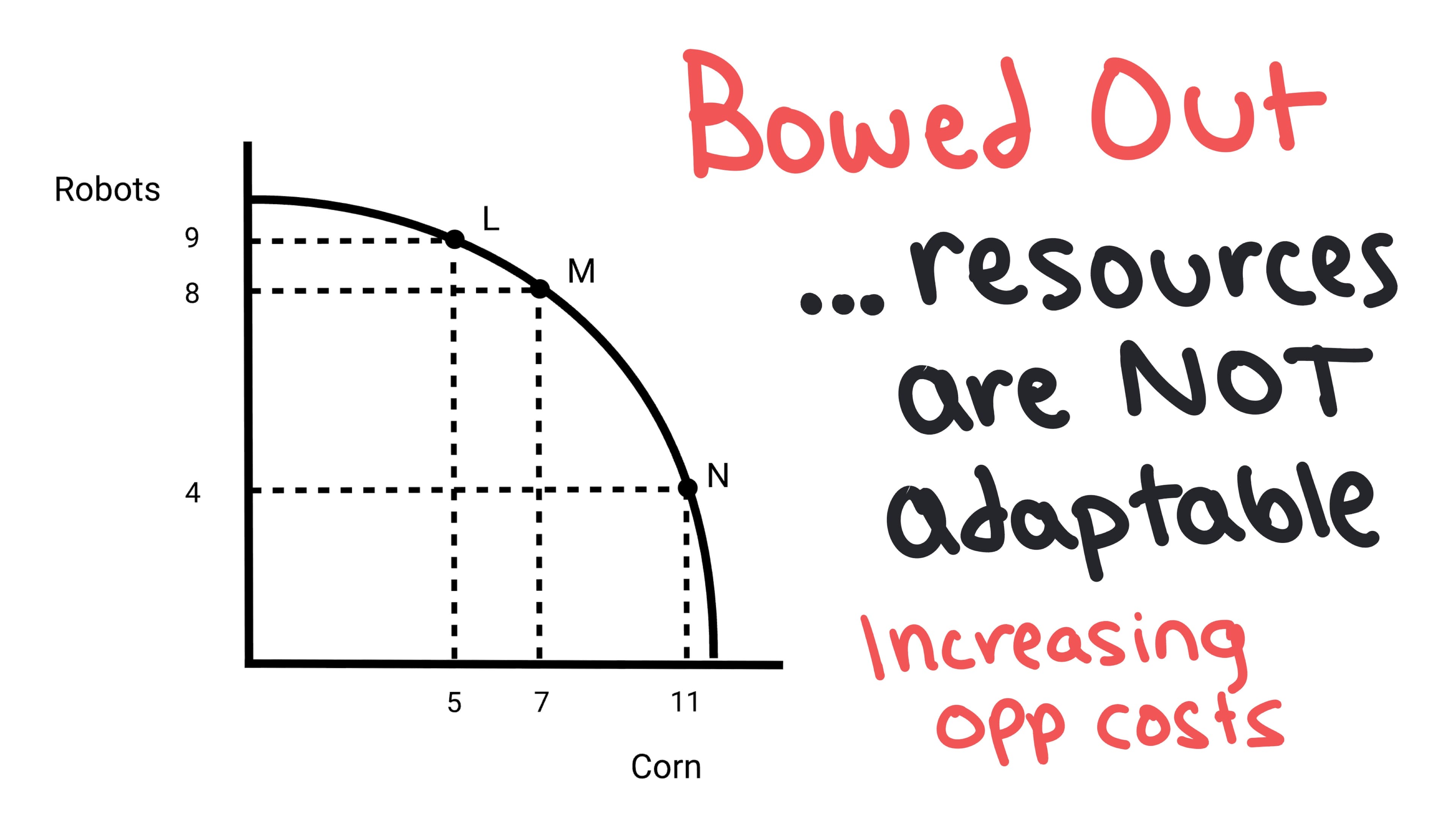
Opportunity Cost
The next best alternative that must be given up when making a choice.
- •The value of the next best alternative forgone
- •Not just monetary cost, but all sacrificed alternatives
- •Key concept in economic decision-making
- •Helps evaluate the true cost of choices
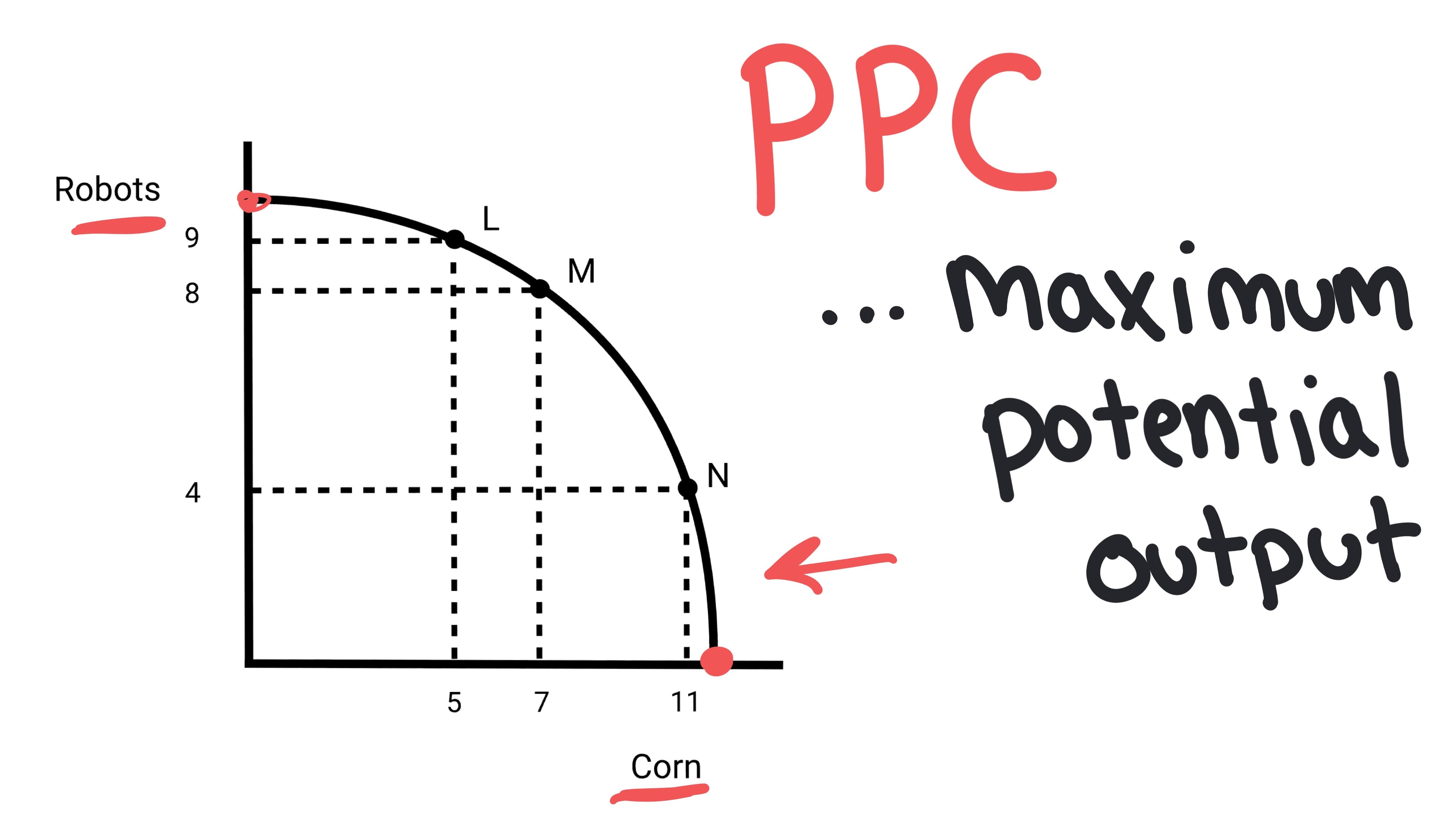
Production Possibilities Curve (PPC)
A model that shows alternative ways an economy can use its scarce resources.
- •Shows maximum possible combinations of two goods
- •Points on the curve represent efficient production
- •Points inside represent inefficient production
- •Points outside are unattainable with current resources
Whiteboards

Checkpoint
Test your understanding of 1.1
What is the fundamental economic problem that exists because resources are limited but wants are unlimited?
Checkpoint
Test your understanding of 1.2
What is the value of the next best alternative that must be given up when making a choice?
1.4 - Comparative Advantage and Trade
Key Terms & Definitions
Comparative Advantage
When a country can produce a good at a lower opportunity cost than another country.
- •Based on opportunity cost, not absolute advantage
- •Determines what countries should specialize in
- •Basis for mutually beneficial trade
- •Allows countries to consume beyond their PPC
Absolute Advantage
When a country can produce more of a good with the same resources as another country.
- •Based on productivity, not opportunity cost
- •Less important than comparative advantage for trade
- •Measures efficiency in production
- •Does not determine trade patterns
Specialization
When individuals, businesses, or nations focus on producing a narrow range of products to maximize efficiency.
- •Focusing on what you do best
- •Increases productivity and efficiency
- •Basis for trade and economic growth
- •Allows for economies of scale
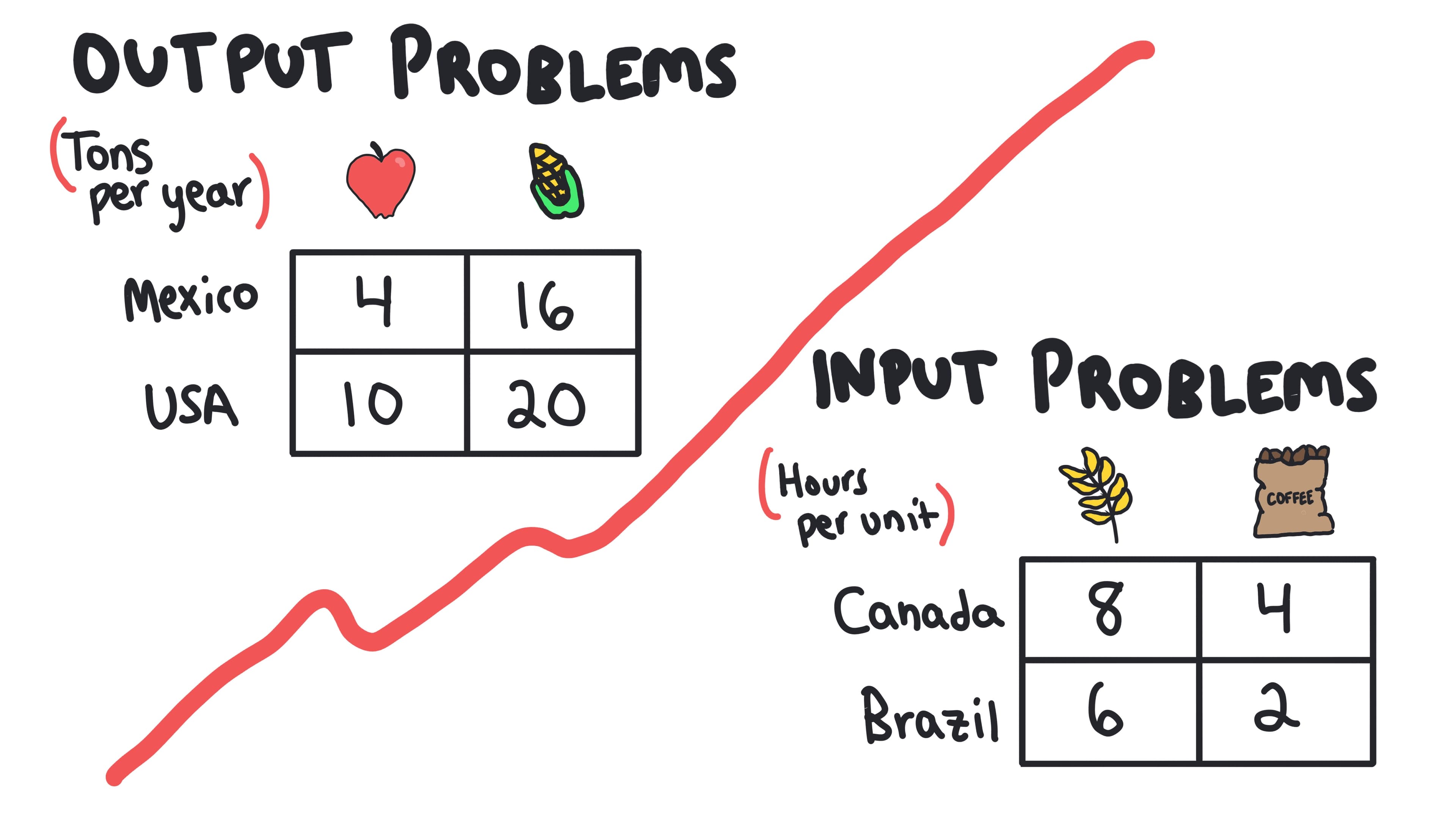
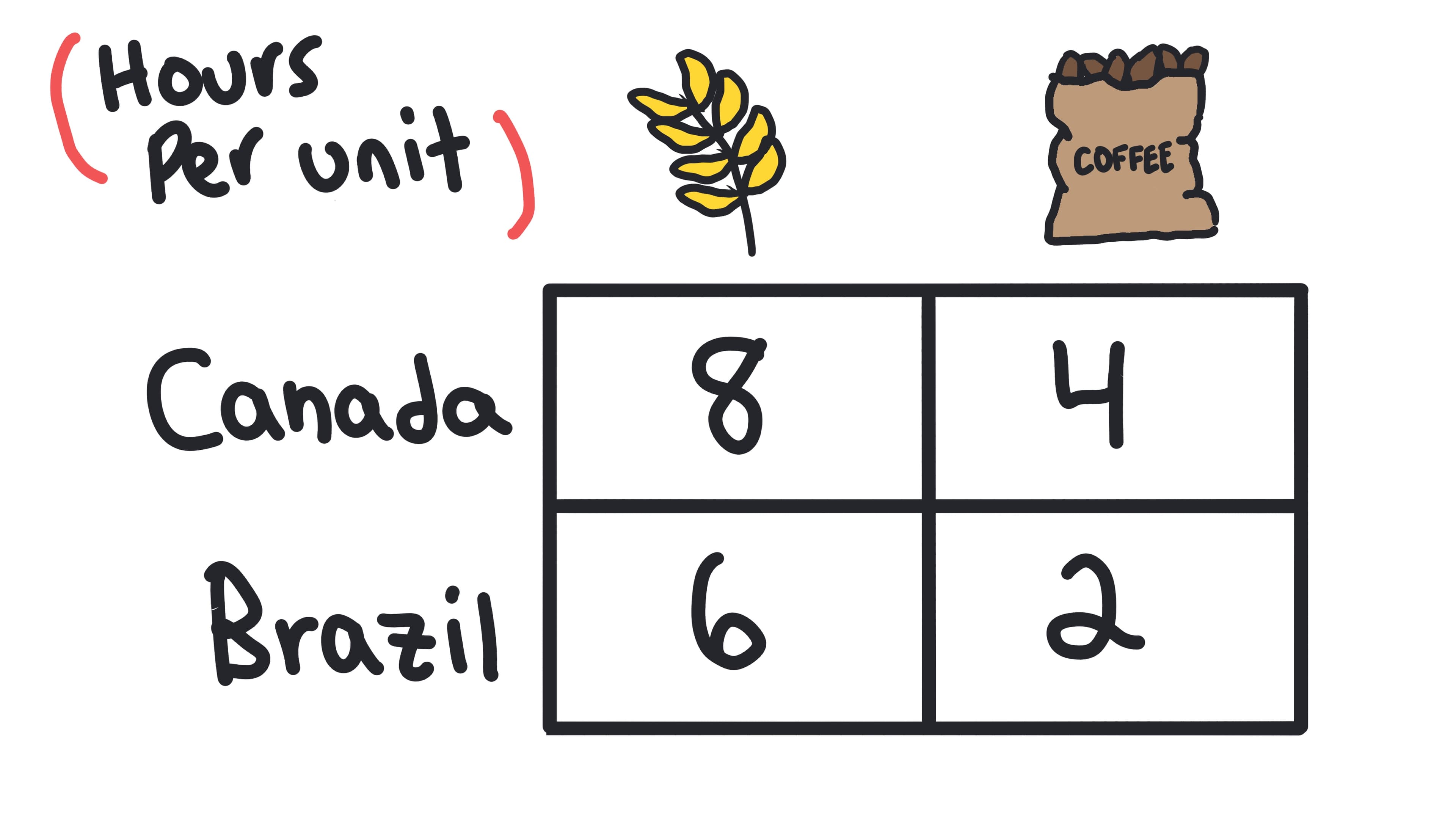
Input Problem
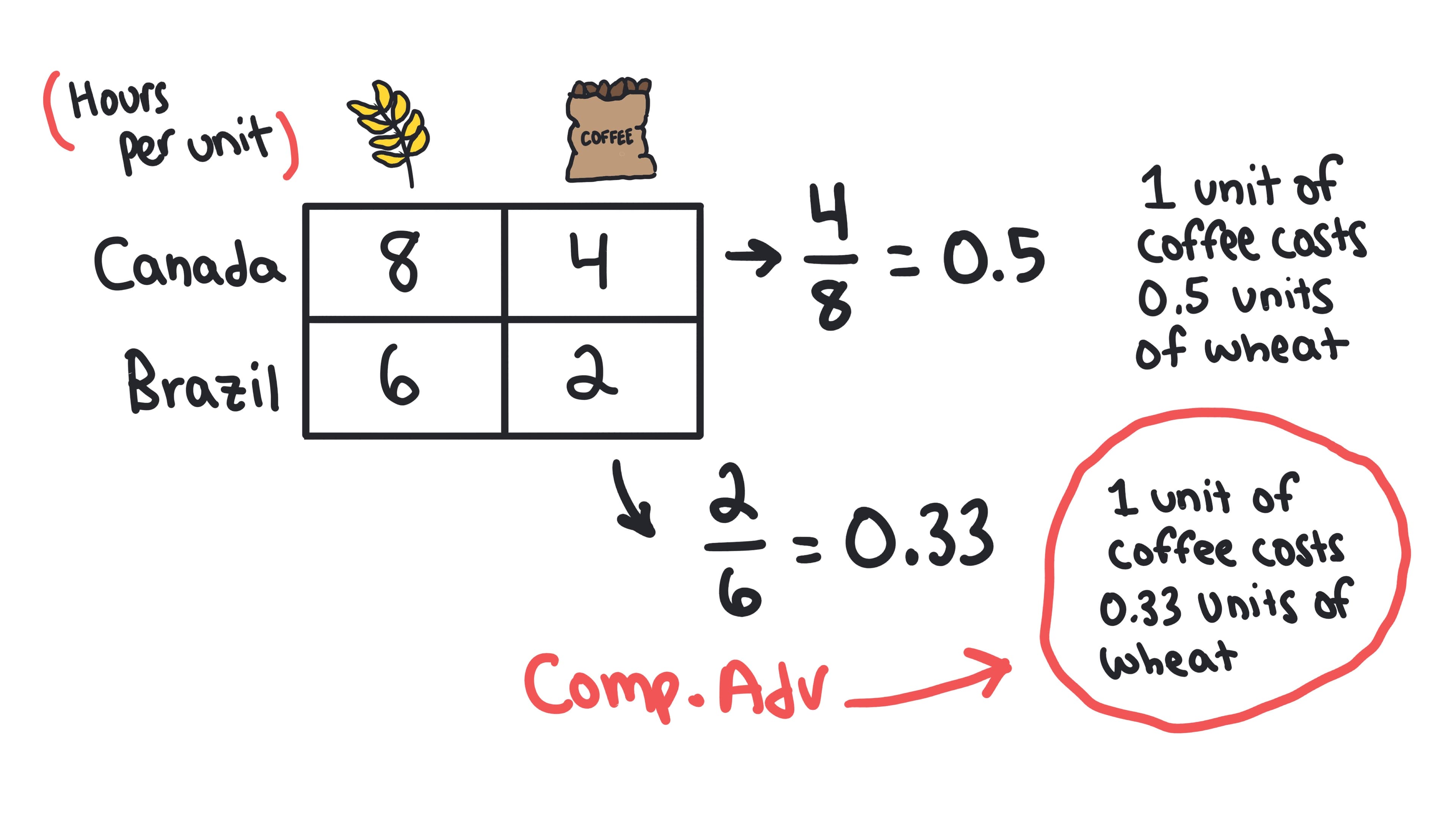
A type of opportunity cost problem where you are given the amount of resources (inputs) needed to produce each good.
- •How to find opportunity cost: Itself / Other
- •Example: If it takes 2 hours to produce Good A and 4 hours to produce Good B, the opportunity cost of 1 Good A is 2/4 = 0.5 Good B. The opportunity cost of 1 Good B is 4/2 = 2 Good A.
Output Problem
A type of opportunity cost problem where you are given the amount of output that can be produced with the same resources.
- •How to find opportunity cost: Other / Itself
- •Example: If a country can produce 10 units of Good A or 5 units of Good B with the same resources, the opportunity cost of 1 Good A is 5/10 = 0.5 Good B. The opportunity cost of 1 Good B is 10/5 = 2 Good A.
Comparative Advantage
The ability to produce a good at a lower opportunity cost than another producer.
- •Focuses on opportunity cost.
- •A country cannot have a comparative advantage in both goods (mathematically impossible).
- •This is the basis for mutually beneficial trade.
Terms of Trade
The rate at which one good can be exchanged for another in trade.
- •To be mutually beneficial, the terms must lie between both parties’ opportunity costs.
- •Example: If Country A cost is 1X for 2Y, and Country B cost is 1X for 4Y, a fair trade is 1X for 3Y.
Whiteboards
1.5 - Cost-Benefit Analysis
Key Terms & Definitions
Cost-Benefit Analysis
A systematic approach to estimating the strengths and weaknesses of alternatives to determine the best option.
- •Rational agents choose the option where Net Benefit (Total Benefit - Total Cost) is maximized.
Explicit Costs
Direct, out-of-pocket payments for inputs (e.g., wages, rent, materials).
- •These are clearly seen on a receipt.
Implicit Costs
The opportunity costs of using resources that the firm or individual already owns (e.g., forgone salary, forgone interest).
- •These are not recorded in accounting books but are crucial for economic decisions.
Total Net Benefits
The difference between the total benefits and the total costs of an action.
- •Rational decision-making aims to maximize this value.
1.6 - Marginal Analysis and Consumer Choice
Key Terms & Definitions
Marginal Analysis
Decision-making based on incremental changes; comparing the additional benefit of an action to the additional cost.
- •Rule: Continue an activity as long as Marginal Benefit (MB) ≥ Marginal Cost (MC).
Utility
A measure of satisfaction or happiness derived from consuming a good or service.
- •Measured in hypothetical units called "utils".
Total Utility
The total amount of satisfaction obtained from consuming a specific quantity of a good.
- •It increases at a decreasing rate due to diminishing marginal utility.
Marginal Utility (MU)
The additional satisfaction gained from consuming one more unit of a good.
- •Formula: Change in Total Utility / Change in Quantity.
Law of Diminishing Marginal Utility
The principle that as a consumer consumes more of a good, the additional satisfaction (marginal utility) from each subsequent unit decreases.
- •Explains why the demand curve slopes downward.
- •Example: The first slice of pizza is great, the fifth slice is just okay.
Utility Maximization Rule
To maximize total utility with a limited budget, a consumer should allocate their income so that the marginal utility per dollar spent is the same for every good.
- •Formula: (MUx / Px) = (MUy / Py)
- •If (MUx / Px) > (MUy / Py), the consumer should buy more X and less Y.
Checkpoint
Test your understanding of 1.4
What determines what countries should specialize in for trade?
Checkpoint
Test your understanding of 1.5
Cost-benefit analysis aims to maximize: